





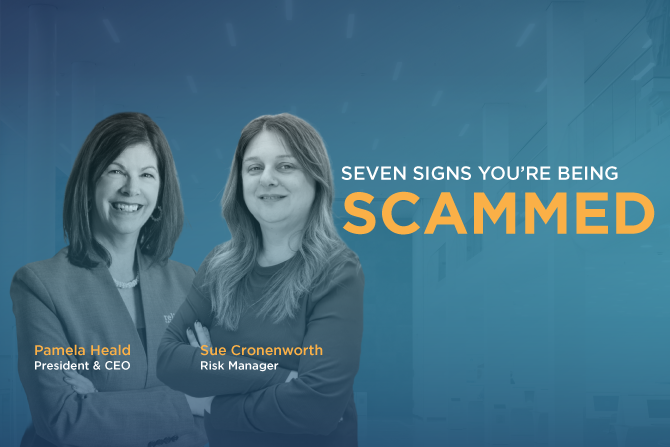
As President & CEO of Reliant Credit Union, I have always prioritized the safety and security of our members’ financial well-being. Recently, during a conversation with Reliant’s Risk Manager, Sue Cronenworth, I was troubled to learn about some new and worrisome scams targeting members in our community. The sophistication of the scams we’re seeing and the large sums of money that scammers have been able to manipulate members into giving them are particularly concerning.
And every one of us should be concerned. One of the biggest myths surrounding fraud and scams is the belief that “other people” get scammed—that it’s only happening far away from here, or that we, surely, are infallible to the deception and manipulation scammers employ. Yet it does happen right here at your credit union. We see it every single day. The number of cases Sue’s Risk team worked to help Reliant members who were victims of scams increased 55% in 2024 over the previous year. It’s also widely believed that the elderly are the primary victims of scams, but the latest data show the opposite is true. The most recent Better Business Bureau Scam Tracker Risk Report found that Americans ages 35 to 44 years old were most likely to be scammed, with those ages 18 to 24 having the biggest median losses due to scams.1
Beyond the financial impact of being scammed, there’s a deep emotional toll—the invasion of privacy, the embarrassment, and the anxiety that follows. It can be difficult for those who have been scammed to talk about it. And yet it’s so important to discuss. The more we can share stories and tips and warn our family and friends, the better we can protect ourselves and one another from the often truly devastating damage scams can inflict.
My conversation with Sue reinforced to both of us the importance of finding more ways to talk to you, our valued members, about fraud, to help you better understand and to help you protect yourselves from the very real threats that are out there. With that in mind, I asked Sue if she could share any common threads between the many varying and ever-evolving scams she’s encountering. If scammers are constantly coming up with new fraud schemes, the best defense involves knowing the surefire indicators someone is trying to scam you.
Here are Sue’s top 7 ways to spot a scam in the moment:
- You feel that something is off. It may sound like common sense, but scammers are trained to exploit our vulnerabilities to influence how we act and respond. If you ever feel uneasy during a phone call, text, email, or social media interaction, trust your instincts and end the conversation. Scammers often impersonate people or organizations you know and trust, such as friends, family members, or well-known institutions. Be especially cautious if someone reaches out in an unusual way—like from a new social media account, unfamiliar email address, or different phone number. To confirm legitimacy, contact the person or organization directly using a verified phone number.
Scammers may even try to manipulate your interactions with those you know and trust, coaching you on what to say or encouraging you to lie when speaking to your friends, family, or even to Reliant. If your gut tells you something isn’t right—such as feeling uncomfortable about lying to your family or your credit union—listen to your instincts. - There is an aggressive tone. Many scams involve threatening behavior, attempting to use scare tactics or threats of consequences if you don’t take immediate action. While this behavior may seem like a dead giveaway, scammers are skilled at manipulating situations, and in the heat of the moment, you may become vulnerable. If someone who has reached out to you becomes aggressive or threatening in an effort to pressure you into action, it is a scam.
- They contact YOU and ask you to provide sensitive information. Be extremely cautious if someone contacts you claiming to be from Reliant, a government agency (like the IRS or FBI), local law enforcement, or a utility company. Government agencies rarely, if ever, initiate contact by phone, and we at Reliant will never—ever—call or text you to request your online banking credentials, full debit/credit card number, one-time verification code, social security number, or any other confidential information. If anyone reaches out to you and asks for these details, it is a scam. In the case of a legitimate fraud alert—a call or text from Reliant to ask about potential fraud—the representative will only ask simple yes/no questions and will never request further personal information.
- What they’re claiming doesn’t make sense. When scammers impersonate representatives from agencies or organizations, what they ask you to do may not line up with the agencies’ typical responsibilities. For example, they might ask you to do something odd, like sending money to prove you’re a “good person,” to “protect your identity,” or to resolve an issue that doesn’t seem related to their supposed organization. These are major red flags. It’s natural to feel panicked when someone pressures you to act quickly, especially if they claim there could be real consequences if you don’t comply with their requests, but take a moment to pause and think: Would the agency they’re claiming to represent really handle the issue they’re describing? If it doesn’t make sense, it’s likely a scam.
- They ask you to buy something or move funds in an untraceable, irreversible way. If anyone contacts you and says that you must buy gift cards, make wire transfers, use payment apps or buy cryptocurrency as a means of payment, it is a scam. These forms of payment are attractive to scammers because they’re difficult—if not impossible—to recover once sent. A legitimate organization would never pressure you to pay in these ways. If you’re ever unsure, take a step back, verify the request separately, and never rush into sending money in a way you can’t get back.
- They ask for access to your email, phone, or computer. Be wary of anyone asking for remote access to your devices, whether it’s your email, phone, or computer. Unsolicited pop-up ads claiming your computer has a virus are always scams, no matter how urgent or official they seem. Similarly, if a pop-up, email, phone call, or text message urges you to call a number or email an address to resolve an alleged issue relating to your computer or online activity, it is a scam. Fraudsters use these tactics to trick you into giving them control of your device, often to steal sensitive information or install malicious software.
- Your credit union representatives are telling you you’re being scammed. Scammers will often ask victims to complete transactions that raise red flags for credit union staff. Reliant’s member service representatives are trained to ask questions when they’re interacting with you to help protect you from fraud. Trust that these questions are in your best interest; we ask because we care and we don’t want you to experience a financial loss. If our team is telling you that you are likely being scammed, please take their warnings seriously. We are trying to help you. In so many cases—especially if you personally withdraw cash or wire funds—once the money is gone, there’s nothing we can do to get it back for you; it will be your loss, and we want to prevent that for you.
We would love to prevent every instance of fraud possible for our members, yet the unfortunate reality is that scams and scammers will never stop innovating and evolving. Sue’s team hears heartbreaking stories every day from members who have been scammed, and each story is slightly different from the one before it.
What we can do is spread the word—and today I’m asking for your help to do just that. PLEASE, tell your friends, co-workers, and loved ones what you’ve learned, and why being informed and staying vigilant is so important. Encourage them to share this article with someone else. Understanding some of the hallmarks of scams—and recognizing that scams are happening every day, everywhere, and to people in every walk of life—can only help to prepare us in the event we are targeted. Thank you for your help in preventing more people from suffering the emotional and financial toll of being the victim of a scam.
And thank you, as always, for belonging to a local credit union where we care about you, and we look out for your best interests. We always want to help, so if you or someone you know have concerns about a possible scam or if you would like advice, please always feel welcome to call us at 800-724-9282 or stop by any branch, and we will be here for you.
Pamela Heald
President & CEO